

Standard Chartered has initiated coverage of Chainlink with an ambitious long-term price target of $200 for LINK by the end of 2030.
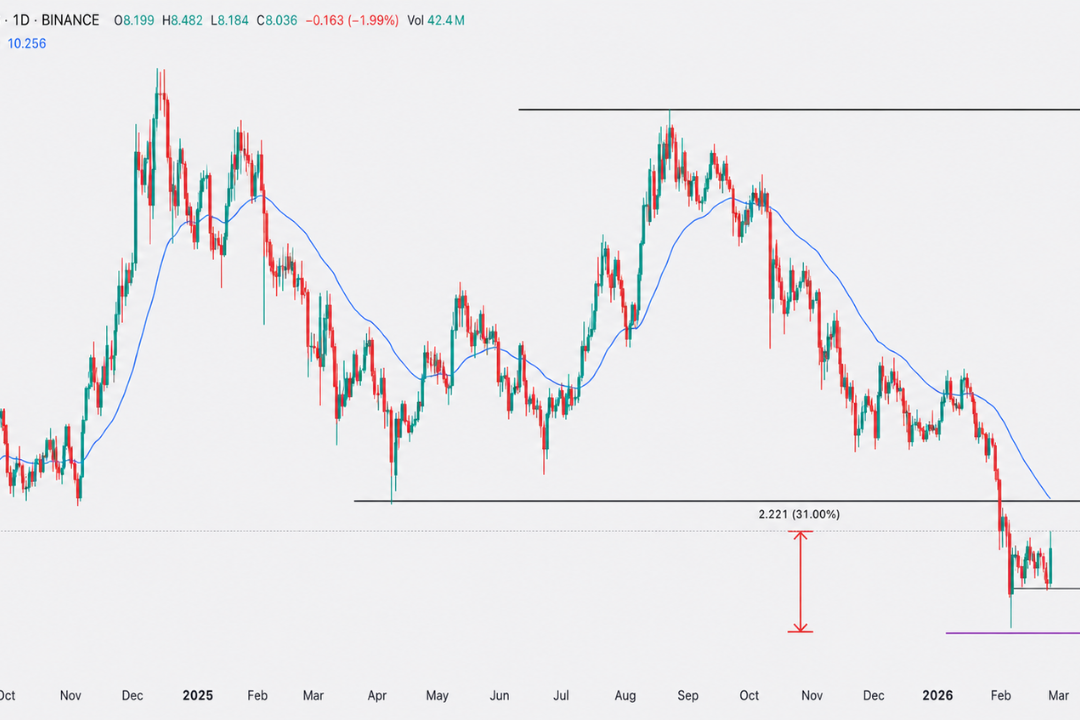
With LINK trading around $8.25 at the time of the report, the forecast implies a potential increase of roughly 25 times from current levels.
The bank believes Chainlink could benefit from rapid growth in tokenized assets, decentralized finance, institutional blockchain adoption, and cross-chain transactions. However, the forecast depends heavily on Chainlink maintaining its dominant position in the oracle market and continuing to attract both crypto-native and traditional financial institutions.
Standard Chartered Sets a $200 LINK Price Target
Geoff Kendrick, Standard Chartered’s Global Head of Digital Assets Research, outlined a staged price forecast for Chainlink.
According to the bank’s projections, LINK could reach:
- $13 by the end of 2026
- $41 in the following stage
- $82 later in the forecast period
- $133 before 2030
- $200 by the end of 2030
LINK was trading near $8.25 when the report was published, meaning the final target would represent a gain of around 25 times.
The forecast is considerably more bullish than the token’s current market position and assumes significant expansion of Chainlink’s underlying network activity.
Chainlink Could Outperform Bitcoin and Ethereum Under the Forecast
Standard Chartered’s Chainlink outlook would imply stronger percentage returns than the bank currently expects for Bitcoin and Ethereum over the same period.
The bank has previously projected Bitcoin could reach $500,000 by 2030.
It has also forecast Ethereum reaching approximately $40,000 by the end of the decade.
Chainlink’s estimated rise from around $8 to $200 would represent a much larger percentage increase.
However, a smaller market capitalization also means LINK could experience significantly higher volatility than Bitcoin or Ethereum.
Chainlink Fees Could Increase 25-Fold
A central part of Standard Chartered’s valuation model is expected growth in Chainlink fees.
The bank believes that as tokenized financial assets and DeFi applications expand, more protocols will need access to Chainlink services.
Chainlink provides infrastructure that allows blockchain applications to receive external data and communicate between different networks.
These services include:
- Price feeds
- Proof of Reserve
- Cross-chain messaging
- Token transfer infrastructure
- Financial data delivery
- Smart contract automation
Standard Chartered estimates that fees generated by these services could increase about 25 times by 2030.
LINK Price Could Track Network Fee Growth
The bank’s $200 target assumes that LINK’s market value will broadly follow the growth of Chainlink’s network economics.
If more applications pay for Chainlink services, demand for the infrastructure could increase.
That does not automatically guarantee a similar increase in the LINK token price.
Token prices can be influenced by broader market conditions, supply, investor sentiment, competition, and token economics.
Still, Standard Chartered views rising fees as one of the strongest fundamental arguments behind its valuation.
Tokenized Assets Could Reach $4 Trillion
The bank expects tokenization to become one of the most important growth drivers for Chainlink.
Standard Chartered estimates that the value of tokenized assets held on blockchains could rise from approximately $340 billion today to $4 trillion by the end of 2028.
Tokenized assets can include:
- Bonds
- Treasury securities
- Investment funds
- Stocks
- Real estate
- Commodities
- Stablecoins
Many of these products require trusted external data before they can operate effectively on-chain.
That creates a potential market for Chainlink’s oracle services.
DeFi Assets Could Expand 37-Fold
Standard Chartered is also highly bullish on decentralized finance.
The bank expects assets deployed across DeFi protocols to increase roughly 37 times to approximately $2.7 trillion by 2030.
If that happens, oracle demand could rise significantly.
DeFi applications regularly need reliable information about:
- Asset prices
- Interest rates
- Collateral values
- Liquidation thresholds
- Reserve levels
Chainlink is already one of the leading providers of this information.
Continued DeFi growth could therefore translate into greater usage of its infrastructure.
Chainlink Secures More Than $110 Billion
Standard Chartered estimates that Chainlink currently helps secure more than $110 billion in value.
The bank says this represents around 70% of oracle-dependent DeFi value globally.
On Ethereum, Chainlink’s share is estimated to be above 80%.
That gives the network a strong existing position as the oracle provider for major decentralized finance applications.
Maintaining that dominance is a key part of Standard Chartered’s long-term forecast.
Aave Represents a Large Share of Chainlink Usage
Aave V3 alone accounts for approximately 44% of the value secured by Chainlink, according to Standard Chartered.
Aave relies heavily on accurate pricing information because its lending markets need to know the value of collateral in real time.
Incorrect oracle information could potentially cause:
- Wrong liquidations
- Bad debt
- Incorrect borrowing limits
- Mispriced collateral
This makes reliable oracle infrastructure essential for large DeFi protocols.
Institutional Adoption Supports the Bullish Case
Standard Chartered’s thesis is not based only on DeFi.
The bank also highlighted Chainlink’s relationships with major traditional financial institutions.
The report identified organizations including:
- Swift
- DTCC
- Euroclear
- JPMorgan
- Mastercard
- UBS
- Fidelity
- S&P Global
These institutions have worked with Chainlink technology across different blockchain and tokenization projects.
Standard Chartered expects institutional customers to become an increasingly important source of Chainlink usage.
Tokenized Finance Requires Reliable Data
Traditional financial products depend on large amounts of trusted information.
A tokenized investment fund may require updated net asset values.
A tokenized bond may need interest-rate data.
A stablecoin may require reserve verification.
A tokenized Treasury product may need pricing and settlement information.
Chainlink can provide these datasets to blockchain-based applications.
If more traditional financial markets move on-chain, demand for secure oracle infrastructure could grow significantly.
Chainlink Works With Swift and Global Banks
One of the most important parts of Chainlink’s institutional strategy has been its work with Swift.
The goal has been to connect existing financial messaging infrastructure with blockchain networks.
This allows banks to interact with tokenized assets without completely rebuilding their current systems.
Such integrations could make blockchain adoption easier for institutions because they can continue using familiar operational infrastructure.
Project Pangea Expands Institutional Testing
In June, Chainlink joined Project Pangea alongside FairSquareLab, UniKA, and Qivalis.
The project is testing stablecoin-based foreign exchange settlement between Europe and South Korea.
Chainlink said the initiative involves more than 50 banks representing over $10 trillion in assets under management.
The project combines blockchain technology with ISO 20022 financial messaging and existing Swift infrastructure.
Stablecoins Could Transform Foreign Exchange Settlement
Project Pangea is testing payment-versus-payment settlement using compliant euro and South Korean won stablecoins.
Payment-versus-payment systems are designed to reduce settlement risk.
Instead of one side of a foreign exchange trade completing before the other, both sides can settle together.
Blockchain infrastructure could potentially make this process:
- Faster
- More transparent
- Available for longer hours
- Easier to automate
Chainlink’s role is to help connect systems and provide the infrastructure needed for secure settlement.
CCIP Is Another Major Growth Driver
Standard Chartered also highlighted Chainlink’s Cross-Chain Interoperability Protocol, better known as CCIP.
CCIP allows applications and tokens to move information and value between different blockchain networks.
Cross-chain interoperability is becoming increasingly important because digital assets are spread across many separate networks.
A token launched on Ethereum may also need to operate on:
- Arbitrum
- Base
- Solana
- Avalanche
- Other blockchains
CCIP is designed to provide standardized infrastructure for those transfers.
CCIP Volume Reached $4.9 Billion in Q2
According to Standard Chartered, quarterly CCIP transaction volume reached approximately $4.9 billion during the second quarter.
That represented a 353% increase compared with the same period a year earlier.
Rapid growth in CCIP usage strengthens the argument that interoperability could become a major business for Chainlink.
However, the bank also noted that Chainlink still trails LayerZero in parts of the interoperability market.
More Than $7 Billion Reportedly Migrated to CCIP
Standard Chartered said more than $7 billion in token value has migrated from older bridge infrastructure to Chainlink CCIP following a major bridge exploit in April.
Several large protocols have reconsidered their cross-chain infrastructure following security incidents.
These migrations can significantly increase the value flowing through Chainlink systems.
They also strengthen Chainlink’s reputation as an institutional-grade interoperability provider.
BitGo Chooses Chainlink for Wrapped Bitcoin
One of the largest recent migrations came from BitGo.
On Aug. 4, BitGo selected Chainlink CCIP as the exclusive cross-chain infrastructure for Wrapped Bitcoin.
The company replaced LayerZero for WBTC transfers.
At the time, WBTC had a market capitalization of roughly $7.4 billion.
That made the decision one of the largest announced migrations involving Chainlink.
WBTC Will Use Chainlink’s Cross-Chain Token Standard
BitGo said it would standardize Wrapped Bitcoin deployments around Chainlink’s Cross-Chain Token framework.
CCIP will also become the default interoperability infrastructure for future digital assets issued by BitGo.
Importantly, BitGo retains control over important operational settings such as:
- Token contracts
- Transfer limits
- Asset management rules
Chainlink provides the communication and transfer infrastructure rather than controlling the underlying asset.
Announced Migrations Reach Roughly $14.6 Billion
When earlier announcements from Mantle, Lombard, Aave, Kraken, and other projects are included, publicly announced migrations from LayerZero-related infrastructure toward Chainlink reached roughly $14.6 billion after the BitGo decision.
That figure demonstrates the potential scale of Chainlink’s cross-chain opportunity.
Still, announced asset value should not be confused with actual recurring transaction revenue.
Standard Chartered’s forecast depends on these integrations producing sustained usage.
Bridge Exploit Increased Attention on Security
The migration trend followed a reported $292 million exploit involving a KelpDAO bridge using LayerZero-related infrastructure.
KelpDAO blamed LayerZero for the incident and announced plans to rebuild using Chainlink.
LayerZero disputed that characterization.
The disagreement highlights how difficult it can be to assign responsibility in complex cross-chain systems involving multiple protocols and smart contracts.
Nevertheless, major bridge exploits generally increase demand for more secure interoperability infrastructure.
Aave Expands Its Use of Chainlink CCIP
Chainlink has also expanded through deeper relationships with existing customers.
In July, Aave made CCIP the default cross-chain infrastructure across the Aave App and Stable Vaults.
The integration expanded an existing relationship.
CCIP was already being used for GHO stablecoin transfers and cross-chain governance messages.
The expanded deployment means Chainlink infrastructure can support more of Aave’s cross-chain activity.
CCIP Supports Aave Deposits and Withdrawals
Aave said its expanded CCIP integration can handle:
- Deposits
- Withdrawals
- Vault rebalancing
- Asset transfers
- Yield optimization
Stable Vaults can move assets between Ethereum, Base, and Arbitrum without users manually bridging tokens.
This improves the user experience by hiding some of the complexity normally associated with cross-chain transactions.
GHO Is Available Across Multiple Networks
Aave’s GHO stablecoin also uses Chainlink’s Cross-Chain Token standard.
The stablecoin was reportedly available across eight blockchain networks by July.
CCIP manages transfers between supported chains.
As more stablecoins operate across multiple networks, secure interoperability becomes increasingly important.
This could create another recurring source of Chainlink usage.
United Stables Also Adopts Chainlink
United Stables added Chainlink infrastructure in July after its U stablecoin surpassed $1 billion in circulating supply.
The stablecoin was also recording approximately $2.5 billion in daily trading volume.
Chainlink Data Feeds and Proof of Reserve were introduced for U.
United Stables also said it planned to integrate CCIP for future cross-chain transfers.
Proof of Reserve Adds Transparency
Chainlink Proof of Reserve allows users and applications to verify information about asset backing on-chain.
For stablecoins, this can help demonstrate whether reserves exist to support circulating supply.
This type of infrastructure could become increasingly important as regulators demand greater transparency from stablecoin issuers.
Chainlink’s combination of price feeds, reserve verification, and interoperability gives it several ways to generate usage from the same institutional or DeFi customer.
Standard Chartered Has Made Other Bullish DeFi Forecasts
Kendrick has used similarly optimistic DeFi growth assumptions in several recent research reports.
Standard Chartered previously set:
- A $100 target for Uniswap’s UNI
- A $3,500 target for Aave’s AAVE
- A $60 target for Morpho
These projections are based partly on the same expectation that DeFi assets could increase dramatically by 2030.
The Chainlink target is therefore part of a broader bullish view on decentralized financial infrastructure.
LINK’s Immediate Market Reaction Was Limited
Despite the ambitious $200 forecast, LINK’s price reaction was relatively modest when the report appeared.
The token was trading near $8.25 and was down roughly 0.8% over the previous 24 hours.
This shows that analyst price targets do not always create an immediate market response.
Long-term forecasts typically matter more if the underlying adoption trends begin matching the assumptions behind them.
Standard Chartered Identifies Several Risks
The bank also acknowledged that its forecast could fail.
One major risk is slower-than-expected institutional tokenization.
Many banks and financial companies are currently experimenting with blockchain technology.
However, pilot programs do not always become large production systems.
If institutions remain in the testing phase for several more years, Chainlink’s fee growth could be significantly lower than projected.
Tokenization May Grow Slower Than Expected
Standard Chartered expects tokenized assets to reach around $4 trillion by the end of 2028.
That is an aggressive assumption.
Regulation, technology, market demand, and institutional caution could all slow adoption.
If tokenization grows more slowly, Chainlink would have fewer opportunities to provide oracle and interoperability services.
That would weaken the bank’s $200 valuation case.
Competition Remains a Major Threat
Chainlink is not the only provider of blockchain data and interoperability infrastructure.
The market includes specialist oracle networks, bridge providers, and cross-chain messaging platforms.
Standard Chartered specifically noted that Chainlink still trails LayerZero in parts of interoperability.
Other competitors could also gain market share.
If Chainlink loses its dominant position, future fees may not grow at the pace assumed in the forecast.
Technical Failures Could Hurt Confidence
Security is especially important for Chainlink because its infrastructure may eventually support large amounts of financial value.
A serious oracle failure or cross-chain security incident could damage confidence.
This risk becomes even more important as traditional financial institutions depend on Chainlink for tokenized assets.
A single major technical failure could:
- Reduce adoption
- Push customers toward competitors
- Create financial losses
- Increase regulatory scrutiny
The bank therefore views reliability as an essential part of the investment thesis.
LINK Must First Reach $13
Before discussing a $200 target, Standard Chartered’s shorter-term forecast calls for LINK to reach $13 by the end of 2026.
That would represent a significant increase from around $8.
The staged forecast then assumes continued growth toward $41, $82, and $133 before reaching $200.
Each stage depends on increasing adoption and broader growth in blockchain-based finance.
$200 Is a Forecast, Not a Guarantee
The $200 target should be treated as a long-term analyst projection rather than a guaranteed outcome.
Cryptocurrency markets are highly volatile.
Even strong adoption does not guarantee that token prices will follow a specific valuation model.
LINK’s performance will depend on factors including:
- Crypto market cycles
- Network usage
- Fee growth
- Competition
- Regulatory developments
- Token supply
- Institutional adoption
- Investor sentiment
A major change in any of these areas could alter the outlook significantly.
Why Standard Chartered Remains Bullish on Chainlink
Standard Chartered’s bullish case ultimately rests on Chainlink becoming a critical infrastructure layer for both decentralized and traditional finance.
The network already holds a dominant share of the DeFi oracle market.
At the same time, it is expanding into:
- Tokenized assets
- Institutional finance
- Stablecoins
- Cross-chain transfers
- Proof of Reserve
- Global payment systems
If these markets expand dramatically, Chainlink could benefit from several growth trends at once.
Can Chainlink Really Rise 25x by 2030?
Standard Chartered believes it can, but the path depends on ambitious assumptions becoming reality.
For LINK to reach $200, Chainlink would likely need to maintain its oracle leadership, significantly expand CCIP usage, convert institutional pilots into recurring production activity, and benefit from major growth in DeFi and tokenization.
The bank expects Chainlink fees to increase about 25 times by 2030 and assumes LINK’s valuation could broadly follow that growth.
For now, the first milestone is much closer.
Standard Chartered expects LINK to reach $13 by the end of 2026 before beginning the longer journey toward $200.
Whether that happens will depend less on the headline forecast and more on how quickly real-world usage of Chainlink’s infrastructure continues to grow.
Meta Description:
Standard Chartered predicts Chainlink could reach $200 by 2030 as tokenization, DeFi and CCIP adoption drive a potential 25-fold rise in LINK.
Focus Keyphrase:
Chainlink price $200 by 2030
Disclaimer:
This article is for informational and educational purposes only and does not constitute investment advice. Standard Chartered’s price targets are forecasts based on assumptions that may not materialize, and cryptocurrency prices remain highly volatile.