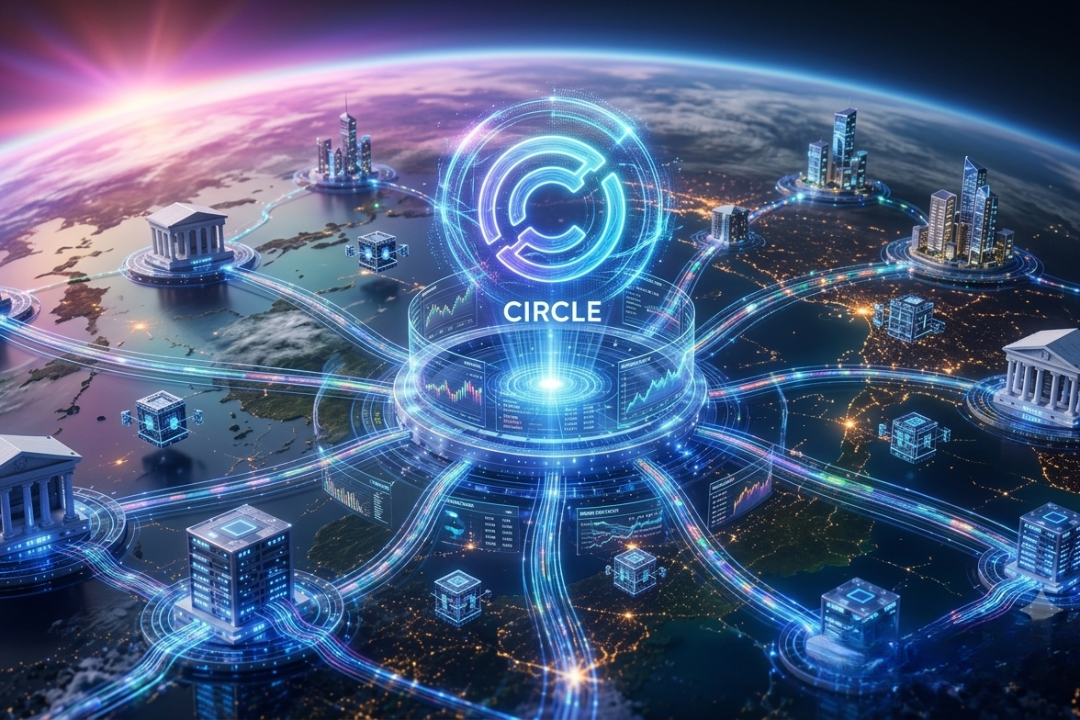

Blockchain networks are powerful at processing transactions and executing smart contracts, but they have one major limitation: they cannot independently access information from the outside world.
That is where Chainlink comes in.
Chainlink is a decentralized oracle network that connects blockchains and smart contracts with real-world information. This can include cryptocurrency prices, weather data, economic indicators, proof of reserves, and information coming from external APIs.
Rather than acting as a simple bridge, Chainlink works more like a verification layer. It gathers information from multiple independent sources, checks that data through its decentralized network, and then delivers the verified result to smart contracts.
This infrastructure has made Chainlink one of the most widely used oracle networks in the blockchain industry.
Why Do Smart Contracts Need Chainlink?
Smart contracts operate inside deterministic blockchain environments. Every validator processing a transaction needs to reach exactly the same result.
That creates a problem when outside information is required.
Imagine an Ethereum smart contract trying to retrieve a stock price directly from a website. Different validators could receive slightly different prices because of network delays, API updates, or connection problems.
If validators receive different information, they may calculate different results and fail to reach consensus.
This limitation is commonly known as the oracle problem.
Blockchains can independently verify information already stored onchain, such as token balances and transactions. However, they cannot determine whether it is raining in Tokyo, what gold currently costs, whether a company beat its earnings forecast, or whether a particular real-world event occurred.
An oracle brings this information onto the blockchain.
Early oracle systems often relied on one centralized data provider. That created another weakness: if the provider failed, delivered outdated information, or was compromised, every smart contract depending on that source could also be affected.
Chainlink approaches the problem differently.
Its decentralized oracle network uses multiple independent node operators and data sources. Their responses are aggregated before a final result is delivered onchain.
This significantly reduces dependence on any single source.
How Chainlink Data Feeds Work
Chainlink Data Feeds are among the network’s most important services.
Consider an ETH/USD price feed.
Independent Chainlink node operators collect ETH price information from multiple data providers. Each node submits its result, and the network aggregates those responses before publishing a final value that smart contracts can use.
For widely used feeds, updates can occur when the price moves beyond a predefined deviation threshold or when a specified heartbeat period expires.
Instead of trusting one exchange or one data provider, the final price therefore represents information gathered from several independent sources.
This decentralized architecture makes manipulating a Chainlink feed considerably more difficult.
Chainlink also uses Offchain Reporting, or OCR, to improve efficiency.
Rather than requiring every node to submit a separate blockchain transaction for each update, nodes can communicate and reach consensus offchain. A single result signed by the required group of nodes is then submitted onchain.
This reduces gas costs while maintaining decentralized verification.
As of mid-2026, the source article reports that Chainlink Data Feeds secure approximately $33.1 billion across 505 protocols.
Chainlink Goes Beyond Cryptocurrency Prices
Although Chainlink became widely known for its price feeds, its ecosystem has expanded considerably.
The network now provides several services designed for different blockchain applications.
Chainlink VRF
Chainlink Verifiable Random Function, or VRF, provides cryptographically verifiable randomness.
Randomness is particularly useful for blockchain games, lotteries, NFT distributions, and other applications where outcomes need to be unpredictable and demonstrably fair.
Each result includes cryptographic proof, allowing users and applications to verify that the outcome was not manipulated.
Chainlink Automation
Smart contracts cannot simply wake themselves up and execute an action when something happens.
Chainlink Automation provides decentralized infrastructure capable of monitoring predefined conditions and triggering smart contract functions when those conditions are satisfied.
Possible applications include automated liquidations, portfolio rebalancing, and yield-management processes.
Chainlink Data Streams
Data Streams are designed for applications requiring low-latency market information, including derivatives and perpetual futures platforms.
Instead of continuously pushing every update onchain, protocols can retrieve fresh market information when they actually need it.
This approach can improve execution efficiency while helping reduce opportunities for frontrunning.
Proof of Reserve
Chainlink Proof of Reserve allows blockchain applications to verify that assets backing a token actually exist.
This can be particularly useful for stablecoins, wrapped assets, and tokenized real-world assets.
Rather than relying entirely on occasional manual reports, protocols can use oracle infrastructure to receive ongoing information about collateralization.
However, Proof of Reserve does not completely eliminate custodial risk. It mainly improves transparency around whether reported reserves are available.
Chainlink Functions
Chainlink Functions gives developers another way to connect smart contracts with external systems and APIs.
Developers can create custom logic that interacts with information outside the blockchain, expanding the range of applications smart contracts can support.
Possible uses include retrieving sports results, checking identity information, or connecting blockchain applications with enterprise data.
Chainlink CCIP Connects Different Blockchains
One of Chainlink’s biggest expansions is the Cross-Chain Interoperability Protocol, better known as CCIP.
Modern blockchain ecosystems operate across dozens of separate networks. Assets and smart contracts on Ethereum cannot automatically communicate with applications running on another blockchain.
CCIP is designed to address this fragmentation.
It allows applications to send tokens and messages between supported blockchain networks while Chainlink’s infrastructure provides the security layer.
According to the source article, CCIP connects more than 70 blockchains and had processed over $18 billion in cross-chain transfer volume through the first quarter of 2026.
Security is especially important because cross-chain bridges have historically been attractive targets for attackers.
CCIP uses multiple security layers, including a separate risk management network capable of monitoring cross-chain activity and responding to suspicious behavior.
Swift Integration Expands Chainlink’s Institutional Role
Chainlink’s ambitions extend beyond crypto-native applications.
One of the most important examples is its work with Swift.
The source article reports that Swift reached a production milestone in April 2026 involving tokenized bond transactions across blockchain networks and traditional banking infrastructure, with CCIP serving as part of the messaging layer.
Swift’s network includes thousands of financial institutions, making this type of integration particularly important for Chainlink’s institutional strategy.
Other organizations mentioned in connection with Chainlink’s institutional adoption include ANZ, BNY Mellon, and the ADI Foundation.
These developments demonstrate how oracle infrastructure could become increasingly important as traditional financial assets move onto blockchain networks.
What Is the LINK Token Used For?
LINK is the native token associated with the Chainlink ecosystem.
It is an ERC-20 token on Ethereum with a maximum supply of one billion tokens.
According to the source article, roughly 700 million LINK were in circulation as of September 2026.
LINK has several important roles within the Chainlink ecosystem.
Node operators can receive LINK for providing services to the network. LINK can also be staked as economic security, creating financial incentives for participants to behave correctly.
The token is additionally used within Chainlink’s broader ecosystem, including CCIP-related transactions.
How Chainlink Staking Works
Chainlink staking adds another security layer to the network.
Participants can lock LINK to help provide economic security while earning rewards.
The source article states that the community staking pool is capped at 45 million LINK, with variable annual rewards of approximately 4.3% to 4.75%. Node operators may receive higher rewards depending on the staking structure.
Chainlink Economics 2.0 also aims to connect network activity more closely with LINK’s economic model.
Under this approach, fees generated from network usage can contribute to staking rewards and other mechanisms within the ecosystem.
The broader objective is to create an economic relationship between Chainlink adoption, network security, and LINK token utility.
Real-World Uses of Chainlink
Chainlink’s infrastructure can support applications far beyond simple token price tracking.
In decentralized lending, protocols such as Aave, Compound, and Venus can use oracle price information to determine collateral values and trigger liquidations.
Derivatives platforms can use Data Streams and price feeds to settle positions and manage risk.
Real-world asset platforms can use Proof of Reserve and other Chainlink services to provide greater transparency around tokenized assets.
Insurance applications can also use oracles to automate payouts based on real-world events.
For example, a blockchain-based crop insurance contract could automatically trigger compensation if verified weather data showed rainfall falling below a predetermined threshold.
Blockchain games and NFT projects can use Chainlink VRF for verifiable random outcomes.
The source article also highlights a 2026 example involving official US economic data being delivered across blockchain networks using Chainlink infrastructure.
Together, these applications demonstrate why decentralized oracle networks can become an important part of blockchain infrastructure.
Chainlink Still Faces Competition
Chainlink holds a strong position in the oracle market, but it isn’t operating without competition.
Pyth Network has focused heavily on high-frequency and pull-based market information, particularly within ecosystems such as Solana.
Chronicle has strong connections with the Maker ecosystem, while RedStone focuses on modular oracle infrastructure and flexible integrations.
Chainlink’s advantage is the breadth of its ecosystem.
Rather than offering only price feeds, it provides Data Feeds, CCIP, VRF, Automation, Proof of Reserve, Data Streams, and other services under a broader infrastructure stack.
That can make Chainlink attractive to applications requiring several different oracle services.
However, this breadth also introduces challenges.
Chainlink infrastructure can be more expensive than some alternatives. Its origins in the Ethereum ecosystem can also create advantages for competitors that were designed specifically for other blockchain environments.
Another consideration is LINK token concentration.
According to the source article, approximately 300 million LINK remained controlled by Chainlink Labs. This continues to raise questions among some investors about long-term token distribution and potential selling pressure.
Why Chainlink Matters to Blockchain
Chainlink solves one of blockchain’s most fundamental limitations.
Smart contracts are capable of automatically executing complex agreements, but their usefulness is restricted if they cannot securely access information outside their own blockchain.
Chainlink provides the infrastructure needed to connect those two worlds.
Its role has also expanded significantly beyond basic cryptocurrency price feeds. Through products such as CCIP, Data Streams, VRF, Automation and Proof of Reserve, Chainlink is developing a wider infrastructure layer for decentralized applications and increasingly for institutional blockchain systems.
As tokenized assets, cross-chain applications, decentralized finance, and blockchain-based financial products continue developing, reliable external data and secure communication between networks will remain essential.
That is the problem Chainlink is attempting to solve: giving smart contracts access to real-world information without forcing them to depend on a single centralized source.