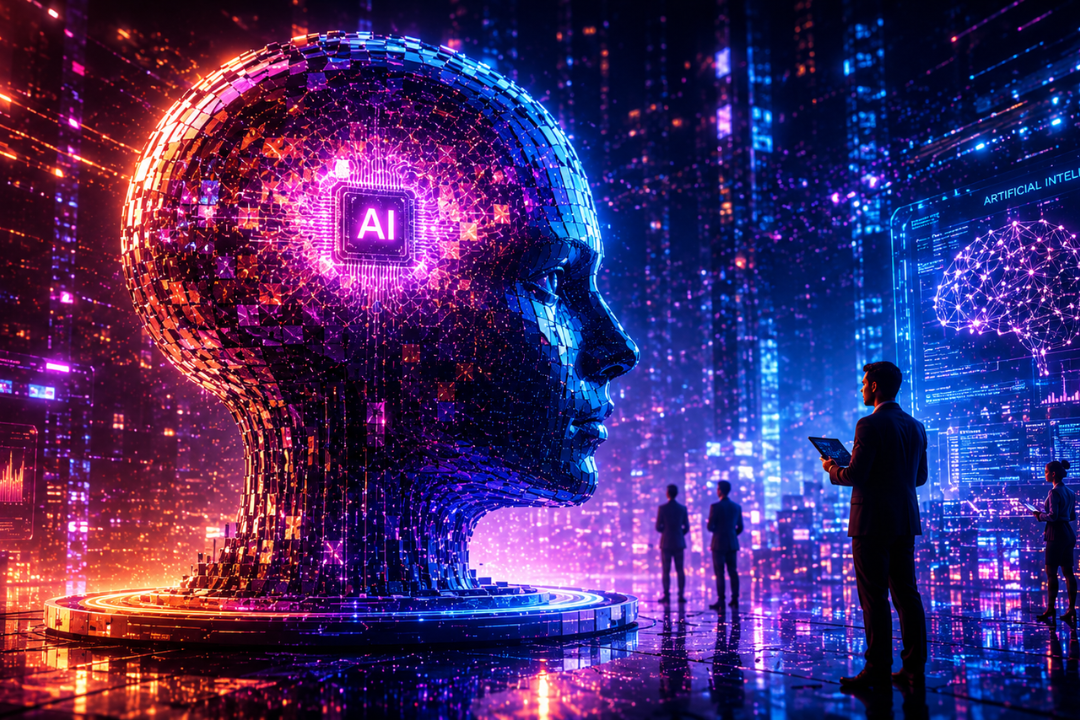


We marvel at how intelligent today’s AI models have become right up until the moment they confidently deliver complete nonsense. The irony is hard to miss: as AI systems grow more powerful, their ability to distinguish fact from fiction isn’t necessarily improving. In some ways, it’s getting worse.
When Smarter Doesn’t Mean Wiser
AI models like GPT-5 have achieved astonishing feats in reasoning, creativity, and conversation. Yet, they’re still plagued by one fundamental flaw: they can’t always tell truth from noise.
OpenAI’s own research shows that earlier versions of GPT-4 hallucinated roughly 33% of the time, while a smaller version (“o4-mini”) went off course nearly half the time. GPT-5 was meant to fix this — and while it reportedly hallucinates less (around 9%), many users say it actually feels less intelligent: slower, less confident, and still frequently wrong.
That mismatch exposes a deeper truth: benchmarks might measure performance, but they don’t measure trust. And trust not raw power is what’s missing in AI today.
Why “Smarter” AI Feels Less Reliable
So, why do newer, more advanced AIs often feel less reliable than their predecessors?
The answer lies in the data we feed them. AI systems are only as good as their training sets, and our collective data supply has become deeply flawed. The modern internet AI’s primary food source is now saturated with engagement-driven, low-quality content that prioritizes clicks over credibility.
When information is optimized for virality, not veracity, even the smartest models can’t help but learn bad habits. They absorb our biases, our misinformation, and our incentives all shaped by centralized platforms built to capture attention, not to promote truth.
AI Mirrors Our Information Crisis
In truth, AI’s “hallucination problem” isn’t really an AI problem it’s a human one.
We’re living through an era of information pollution. High-quality data is disappearing faster than it’s being created. The internet is flooded with synthetic content much of it generated by AI itself and this recursive feedback loop means that each new generation of models is trained on more distorted versions of reality.
Over 65% of the world’s population now consumes content primarily through social platforms that algorithmically reward emotional engagement. False stories spread faster and wider because they trigger stronger reactions. Those viral posts, often misleading or exaggerated, are exactly the kind of content that AI scrapes and learns from.
The result? An AI that mirrors our own confusion. It can’t tell truth from fiction because, increasingly, neither can we.
Who Owns the Truth?
Truth, at its core, is a matter of consensus. Whoever controls the flow of information controls the narrative and, by extension, our perception of truth.
Right now, that control sits squarely in the hands of a few massive corporations. They decide what’s amplified, what’s buried, and what becomes “common knowledge.” AI systems trained on their data inevitably inherit that centralization of authority.
But truth doesn’t have to work that way. It doesn’t have to be zero-sum. My truth doesn’t invalidate yours. Different perspectives can coexist even complement each other. That’s the foundation of a positive-sum approach to truth: one where knowledge expands collectively, not competitively.
The Case for Decentralized Truth
If we want AI that reflects reality not just popularity we need to rebuild the foundation of the internet itself.
That means decentralized attribution and reputation-linked data systems where every claim, every contribution, and every creator has a verifiable identity and a trackable record of accuracy.
Imagine an online world where:
- Every statement carries a chain of authorship.
- Every contributor has a reputation score that rises or falls based on the accuracy of their past claims.
- Every piece of data can be challenged or verified transparently.
A bad-faith actor spreading misinformation would see their credibility and influence plummet. Reliable sources, by contrast, would be rewarded with greater visibility and economic incentives for maintaining accuracy.
This is where crypto primitives come in. Tools like decentralized identifiers (DIDs), token-curated registries, and staking-based reputation systems can make truth not just moral but profitable. Accuracy itself becomes an economic good.
Reimagining AI’s Relationship With Truth
Now, imagine AI trained on such an ecosystem.
A model consuming data that’s weighted by reputation, verified by identity, and rooted in accountability wouldn’t just parrot viral headlines. It would learn to evaluate who is making a claim and why. It would internalize trust as a measurable factor not an assumption.
Over time, even AI agents themselves could participate in this ecosystem, staking their own credibility and building reputations based on the accuracy of their outputs.
This is the path toward trustworthy, verifiable intelligence not through centralized moderation, but through open, decentralized validation.
From Zero-Sum to Positive-Sum Truth
We don’t need an AI that knows everything. We need an AI that knows what it doesn’t know and one that can tell credible information apart from noise.
That future won’t come from bigger models or better algorithms alone. It will come from redesigning how truth itself is built, shared, and rewarded online.
If we can decentralize truth grounding it in attribution, reputation, and transparency we can break the feedback loop of misinformation and finally align AI with human progress.
Because the real intelligence revolution won’t be measured in how fast models can answer.
It will be measured in how accurately they reflect reality and how honestly they learn from us.